Product
The operator record.
One page per operator, built from county recorders, assessor rolls, state registries and federal courts.
Anatomy of a record
The record is the product. Each numbered part matches a marker on the screen.
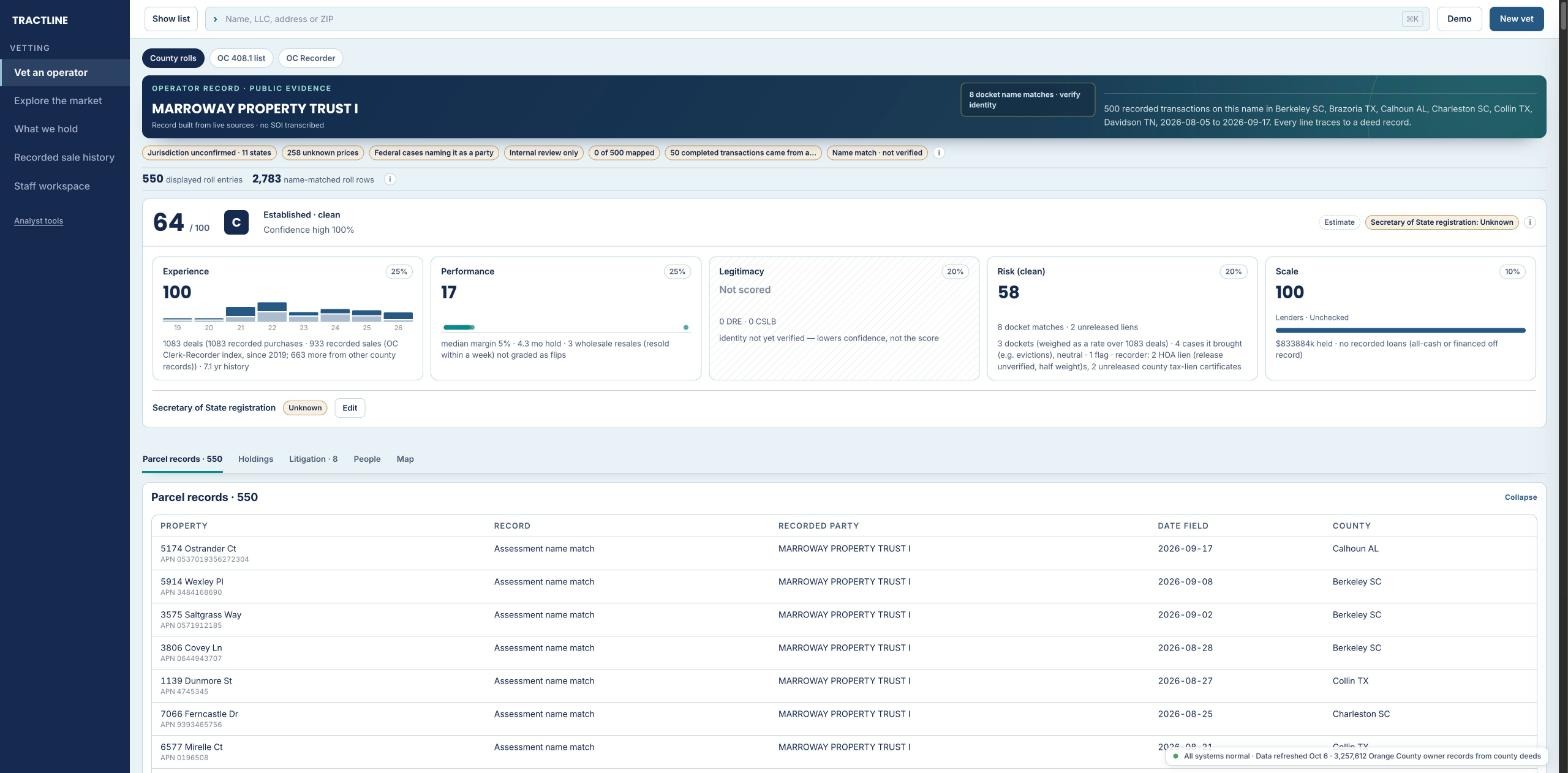
Operator header
The entity, where its transactions were recorded and the date range covered. Every line traces to a deed record.
Caution chips
What the record can't confirm yet: unconfirmed jurisdictions, unknown prices, name-only matches. They sit above the grade, not under it.
Overall grade
A score out of 100, a letter grade and a confidence level. Confidence reflects how much of the record was readable.
Scored categories
Experience, performance, legitimacy, risk and scale, each with its weight and the records that moved it.
Registration check
State registration status for the entity. It raises confidence but adds no points.
Evidence tabs
Parcel records, holdings, litigation, people and map.
Parcel records
Every parcel tied to the entity, with record type, recorded party, date and county.
The evidence tabs
- Parcel records
- Every parcel recorded or assessed under the entity, across counties.
- Holdings
- What the entity still owns today, from assessor and city rolls.
- Litigation
- Federal dockets where the entity is a party, with its role read from the case caption.
- People
- Officers and principals named on state filings, linked across entities.
- Map
- The entity's parcels on a map, where the county publishes coordinates.

Market view
Start from a place instead of a name: recorded parcels, closed comps and recorded distress, on aerial imagery for the county you choose.

What the record says it doesn't know
When a county doesn't publish a sale price, the record says unknown price. When a court match is on name only, it says name match, not verified. When a category has no data, it is not scored, rather than zero.
Your team sees the gaps before it sees the grade.
See a record built on your counties.
We'll walk through an operator you pick.